Why Recording Your Stringings Will Transform Your Game
Do you know exactly what string is on your racket right now? And the tension? When was the last stringing? What was the previous setup like?
If you hesitated on any of these questions, you're missing a valuable opportunity to optimize your game. The difference between players who evolve quickly and those who stagnate often isn't talent or training time, but the ability to make informed decisions about their equipment.
In this article, we'll explore why recording your stringings is one of the most underrated practices in tennis, and how it can significantly accelerate your evolution.
The Problem: Stringing Amnesia
Common scenario:
You take your racket to be strung. The stringer asks: "Same setup as always?"
>
You answer: "Yes... I think so. Or was it a bit different? Actually, I don't remember exactly what I used last time."
This dialogue happens every day in stringing shops around the world. And it represents a bigger problem than it seems.
What you lose without records:
1. Impossibility to compare
- That incredible stringing that worked perfectly? Lost in memory.
- That terrible setup that caused arm pain? You might repeat it without realizing.
2. Decisions based on guesswork
- "I think I was using 24kg" (actually it was 22kg)
- "Seems like it was a blue string" (but which brand? which model?)
3. Evolution without direction
- You change string/tension randomly
- Never know if you're improving or worsening the setup
- Waste money experimenting without method
4. Lack of temporal context
- Don't know how long you've had the same strings
- Don't notice degradation patterns
- Restring too early (waste) or too late (poor performance)
The Solution: Data = Accelerated Evolution
Professional players and serious amateurs have one thing in common: all maintain detailed records of their stringings.
Why? Because in modern tennis, optimized equipment can mean:
- 10-15% more control
- Fewer injuries and discomfort
- Better cost-benefit (don't waste on bad setups)
- Faster technical evolution
Real Case: The Difference Data Makes
John, 35 years old, intermediate:
Without records (Year 1):
- Strung 4x during the year with different setups
- Spent $200 on stringings
- Couldn't explain which worked better
- Ended the year using "whatever string" recommended at the shop
With records (Year 2):
- Recorded each stringing in StringLab
- Identified that Tecnifibre X-One at 22kg was his ideal setup
- Saved $50 not testing random setups
- Improved consistency in local tournaments
The difference? Method based on data vs trial and error without direction.
The 7 Benefits of Recording Stringings
1. Identify Your Ideal Setup Faster
How it works:
When you systematically record:
- String type + Tension + Date
- Performance feedback (control, power, comfort)
- Duration until next stringing
You create a learning map that reveals patterns:
``` Setup A: Wilson NXT 23kg Feedback: Great comfort, lacked control Duration: 2 months
Setup B: Luxilon ALU Power 23kg Feedback: Too stiff, elbow pain Duration: 3 months (but very uncomfortable)
Setup C: Tecnifibre X-One 22kg Feedback: Perfect balance! Duration: 2.5 months ```
Result: You discover your ideal setup in 3-4 attempts instead of years of blind experimentation.
2. Save Money with Smart Experimentation
Each stringing costs $30-60. Experimentation without method can cost hundreds of dollars on setups that don't work.
Without records:
- Repeat bad setups by forgetfulness
- Test expensive strings without necessity
- Don't learn from past mistakes
- Annual spending: $250-350+
With records:
- Know exactly what to avoid
- Experiment in controlled way (1 variable at a time)
- Identify best cost-benefit
- Optimized annual spending: $150-250
Average savings: $80-120/year
3. Avoid Injuries from Inadequate Setup
Wrong setup is one of the main causes of tennis elbow and other injuries.
Signs your records reveal:
``` Date: Jan 15 - Setup: Poly 25kg Feedback: Elbow pain after 3 sets
Date: Feb 20 - Setup: Multi 22kg Feedback: Zero discomfort, complete game without pain
Date: Mar 10 - Setup: Poly 23kg (trying again) Feedback: Pain returned after 2 sets ```
Data-based conclusion: Your body doesn't tolerate poly at high tensions. Avoid permanently.
Without records, you could take years to make this connection, suffering repeated injuries.
4. Optimize Restringing Frequency
How many hours do your strings maintain acceptable performance?
With records, you discover your pattern:
``` Stringing 1: Jan 15 - Changed Mar 20 (2 months, ~24 hours play) Feedback: Strings were dead, should have changed earlier
Stringing 2: Mar 20 - Changed May 5 (1.5 months, ~18 hours play) Feedback: Perfect! Still with good response
Stringing 3: May 5 - Changed Jun 20 (1.5 months, ~18 hours play) Feedback: Ideal timing again ```
Conclusion: Your ideal point is restringing every 18-20 hours of play, regardless of time.
5. Track Your Technical Evolution
Your ideal setup changes as you evolve in tennis.
Example of typical progression:
Year 1 (Beginner):
- Multifilament 1.30mm @ 21kg
- Needs power and comfort
- Rarely breaks strings
Year 2 (Intermediate):
- Multifilament 1.25mm @ 23kg
- Developed more technique, wants more control
- Breaks strings every 2-3 months
Year 3 (Advanced Intermediate):
- Hybrid (poly main + multi cross) @ 24kg
- Generates spin naturally
- Breaks strings monthly
Year 4+ (Advanced):
- Polyester 1.25mm @ 25kg
- Control and spin are priority
- Restrings biweekly
With records, you see this evolution happening and adjust proactively. Without records, you stay stuck in beginner setups even when you've already evolved.
6. Experiment with Confidence
Historical data gives security to experiment.
Scenario: You want to test a new more expensive string ($60 vs your usual $40).
Without records:
- You test and "think" it worked well
- Not sure if it's worth the extra $20
- Decide by guesswork
With records: ``` Current Setup: Tecnifibre X-One @ 22kg Control: 7/10 | Power: 8/10 | Comfort: 9/10 | Duration: 2 months
Test Setup: Luxilon 4G @ 22kg Control: 9/10 | Power: 6/10 | Comfort: 7/10 | Duration: 2.5 months
Data-based decision: +2 control, -2 power, -2 comfort, +0.5 month Extra cost: $20 (+50%) Benefit: Not worth it for my style ```
Result: You make rational choices based on real cost-benefit, not marketing.
7. Receive Smart Alerts
With history, you can calculate when it's time to restring before performance drops.
Data-based alert system:
`` Your pattern: Restring every 18 hours of play Last stringing: Jan 15 Hours played since then: 14h Alert: ~4h remaining until ideal restringing point Suggestion: Schedule stringing for next week ``
This ensures you always play with fresh strings at the ideal performance point.
How to Start Recording (The Right Way)
Method 1: Manual Spreadsheet (Basic)
Minimum information:
| Date | String | Tension | Cost | Duration | Feedback | |------|--------|---------|------|----------|----------| | Jan 15 | Wilson NXT 1.25 | 22kg | $45 | 2 months | Good, but lacked control | | Mar 20 | Luxilon ALU 1.25 | 23kg | $60 | 3 months | Too stiff, arm pain |
Pros:
- Free
- Full control of data
- Simple to start
Cons:
- Manual, easy to forget
- Hard to analyze patterns
- No automatic alerts
- Doesn't stay on racket (may forget which setup you're using)
Method 2: Dedicated App (Recommended)
This is where StringLab comes in.
How it works:
- After stringing, scan QR code on racket
- Automatically record: string, tension, date, stringer
- During play, add quick feedback (1-5 stars for control/power/comfort)
- System learns your pattern and suggests next stringing
- Receive alerts when near ideal time
Exclusive advantages:
- App + QR code: Never forget which setup you're using
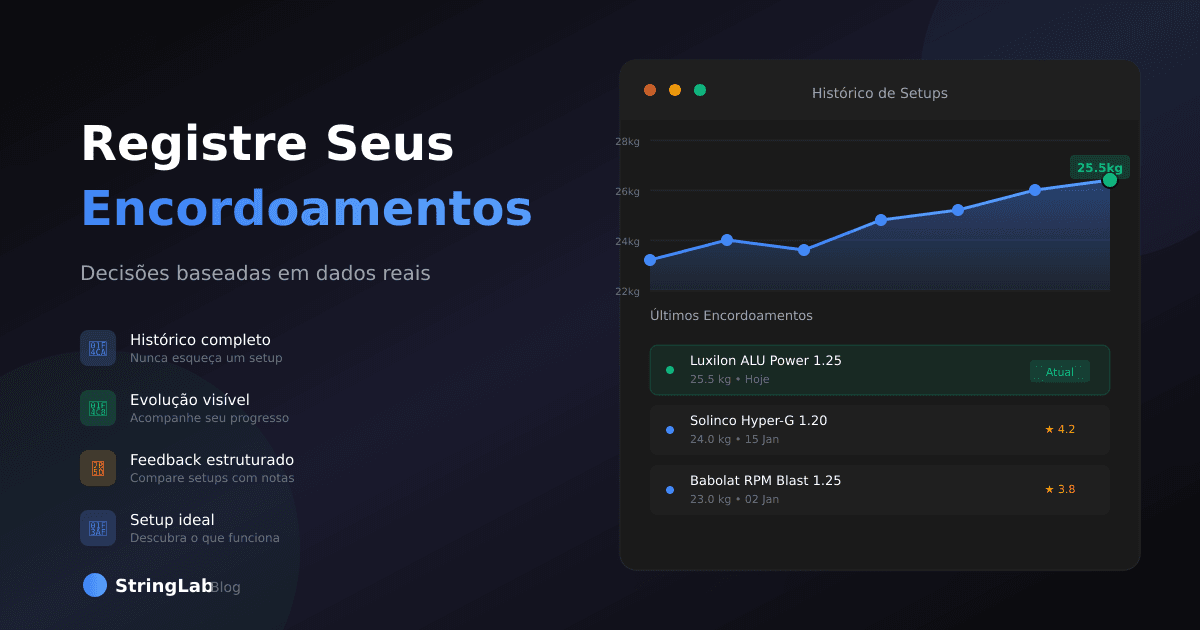
- Evolution graphs: See trends over time
- Smart alerts: Based on YOUR playing pattern
- Side-by-side comparisons: Which setup had better performance?
- Personalized recommendations: Based on your history
- Shop integration: History shared with your stringer
Method 3: Notes on Racket (Emergency)
If you don't use any system:
Immediate solution:
- Stick a small label on the racket handle
- Note: "Wilson NXT 1.25 | 22kg | Jan 15/26"
- At least you know what you're using!
Limitations:
- Doesn't record feedback
- Doesn't compare setups
- Doesn't alert when to change
Template: First Complete Record
Use this template for your next stringing:
```markdown === STRINGING #1 ===
DATE: __/__/____ RACKET: ________________
STRINGS:
- Main: _____________ | Gauge: _____ | Tension: ____ kg
- Cross: ___________ | Gauge: _____ | Tension: ____ kg
(if not hybrid, repeat same string in both)
COST:
- String: $ _____
- Labor: $ _____
- Total: $ _____
STRINGER: _________________ LOCATION: _________________
EXPECTATION: What I expect from this setup:
=== POST-GAME FEEDBACK ===
First impression (after 1h of play):
- Control: 1 2 3 4 5
- Power: 1 2 3 4 5
- Comfort: 1 2 3 4 5
- Spin: 1 2 3 4 5
Comments:
After 2 weeks: Changes noticed: ___________ Overall satisfaction: 1 2 3 4 5
Next stringing: Planned date: __/__/____ Planned changes: ___________ ```
5 Questions Your Data Will Answer
With 6+ months of consistent records, you'll have concrete answers to:
1. "What's my ideal setup?"
Based on satisfaction averages for control, power, and comfort.
2. "How often should I restring?"
Based on performance degradation pattern.
3. "Is it worth paying more for string X?"
Based on real cost-benefit analysis (performance vs price).
4. "Should I increase or decrease tension?"
Based on correlation between tension and satisfaction.
5. "How has my game evolved?"
Based on setup changes over time.
Common Mistakes When Recording
Mistake 1: Recording only string and tension
Problem: Incomplete information prevents analysis Solution: Always include date, cost, and feedback
Mistake 2: Not recording post-game feedback
Problem: You forget how performance was Solution: Add impressions within first 24h
Mistake 3: Changing multiple variables at once
Problem: Don't know which change caused difference Solution: Change 1 thing at a time (e.g., only tension, or only string)
Mistake 4: Giving up after 2-3 records
Problem: Insufficient data for analysis Solution: Commit to at least 6 months of records
Mistake 5: Not reviewing data periodically
Problem: Records but doesn't learn Solution: Review records monthly and draw conclusions
Next Steps: Start Today
You don't need to wait for the next stringing to start.
Immediate action:
1. Record your current setup (even if retrospective):
- What string do you think you're using?
- What approximate tension?
- How long ago did you string?
2. Create your recording system:
- Choose: spreadsheet, app (StringLab), or note on racket
- Set up template you'll use
3. Define commitment:
- "I'll record the next 6 stringings"
- "I'll add feedback after each playing session"
4. Schedule review:
- Mark in calendar: review data every month
- Make adjustments based on identified patterns
Conclusion: Data Is Your Competitive Edge
In modern tennis, the difference between players at the same technical level often lies in optimization details.
While most play with "good enough" setup, serious players have setup optimized for their specific game.
The difference? Data.
Recording stringings isn't "waste of time" or "professional stuff." It's a simple practice that:
- Saves money
- Prevents injuries
- Accelerates evolution
- Maximizes performance
- Brings consistency
The best time to start was at your first stringing. The second best time is now.
Create your account on StringLab, scan the QR code on your racket, and start transforming data into victories!
Also read: